

Airbus A320
Airbus A320 vs 737 Cabin Pressurization: Key Differences Explained

Mar
There’s a common belief that you’ll feel the same in any narrowbody jet, but the A320 vs 737 cabin pressurization systems handle cabin altitude control differently despite sharing the same objective: keeping passengers comfortable and physiologically safe at cruise. Both aircraft are designed to maintain cabin altitude at or below approximately 8,000 feet at their certified maximum operating altitude, though the actual pressure schedule varies by phase of flight and cruise level.
Newer composite widebodies such as the Boeing 787 and Airbus A350 typically operate with a lower cabin altitude—often around 6,000 feet—which many passengers associate with reduced fatigue and fewer ear discomfort issues. In most A320 and 737 variants, cabin air is supplied as conditioned bleed air extracted from the engine compressors, cooled, mixed, and regulated before entering the cabin.
With more than 18,000 A320 family orders recorded by mid-2024 and the 737 remaining Boeing’s best-selling jetliner family, understanding how these pressurization systems function—and how crews manage abnormalities—matters from both an operational and passenger perspective.
The A320 vs 737 cabin pressurization comparison ultimately comes down to philosophy: Airbus prioritizes automation, while Boeing preserves more direct pilot authority. Both aircraft regulate differential pressure using digital controllers and an outflow valve to maintain safe cabin altitude throughout climb, cruise, and descent.
Key Differences at a Glance
| Feature | Airbus A320 | Boeing 737 |
|---|---|---|
| Controllers | Two redundant Cabin Pressure Controllers (CPCs) | Dual digital controllers |
| Philosophy | Highly automated | Automation with manual authority |
| Manual Mode | Available (rarely used in normal ops) | Full manual rate selector control |
| Cabin Rate Control | Automatically scheduled | Selectable 50–2000 fpm |
| Maximum Differential Pressure | ~8.6–8.9 psi (varies by model) | Up to ~9.1 psi (newer models) |
| Pre-Pressurization | 0.1 psi before liftoff | Model dependent |
The Real Deal on the Airbus A320’s “Hands-Off” Approach
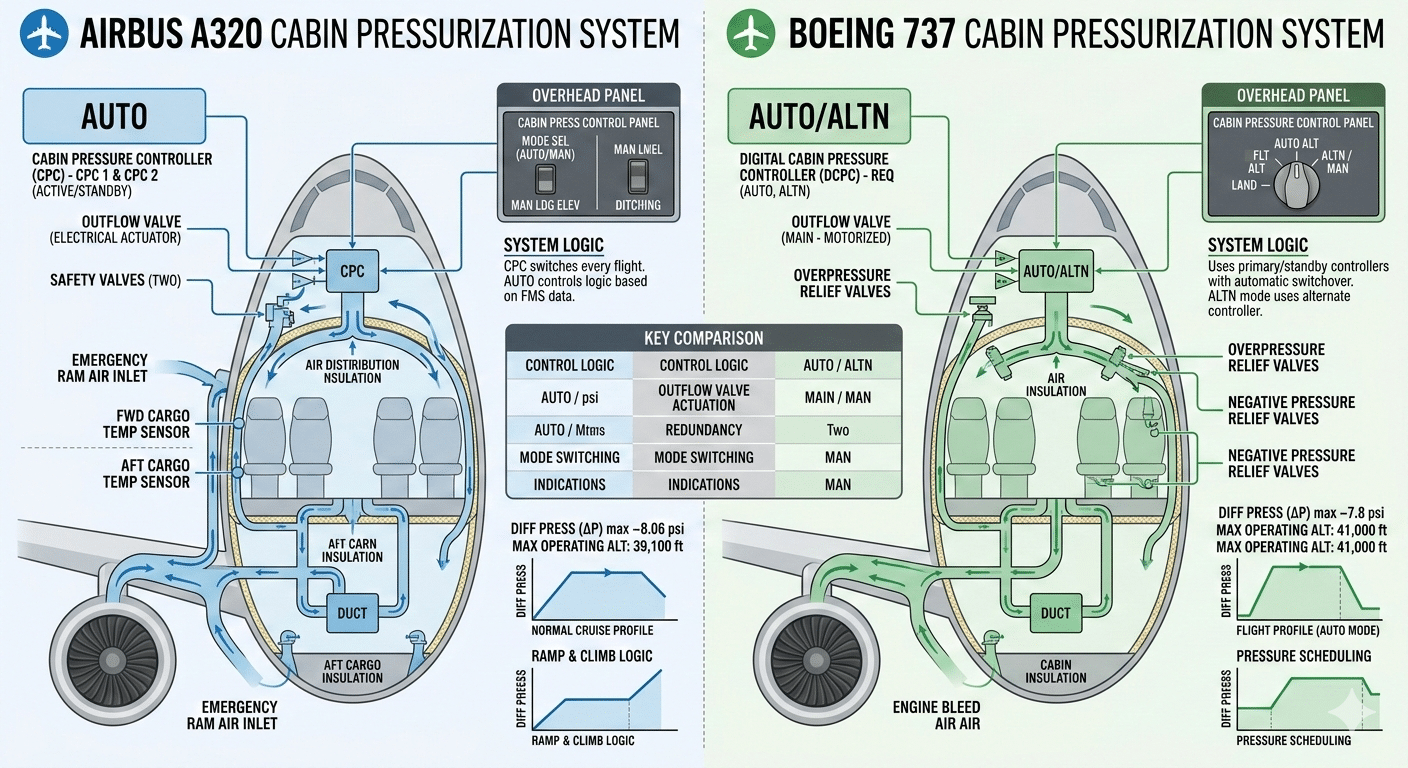
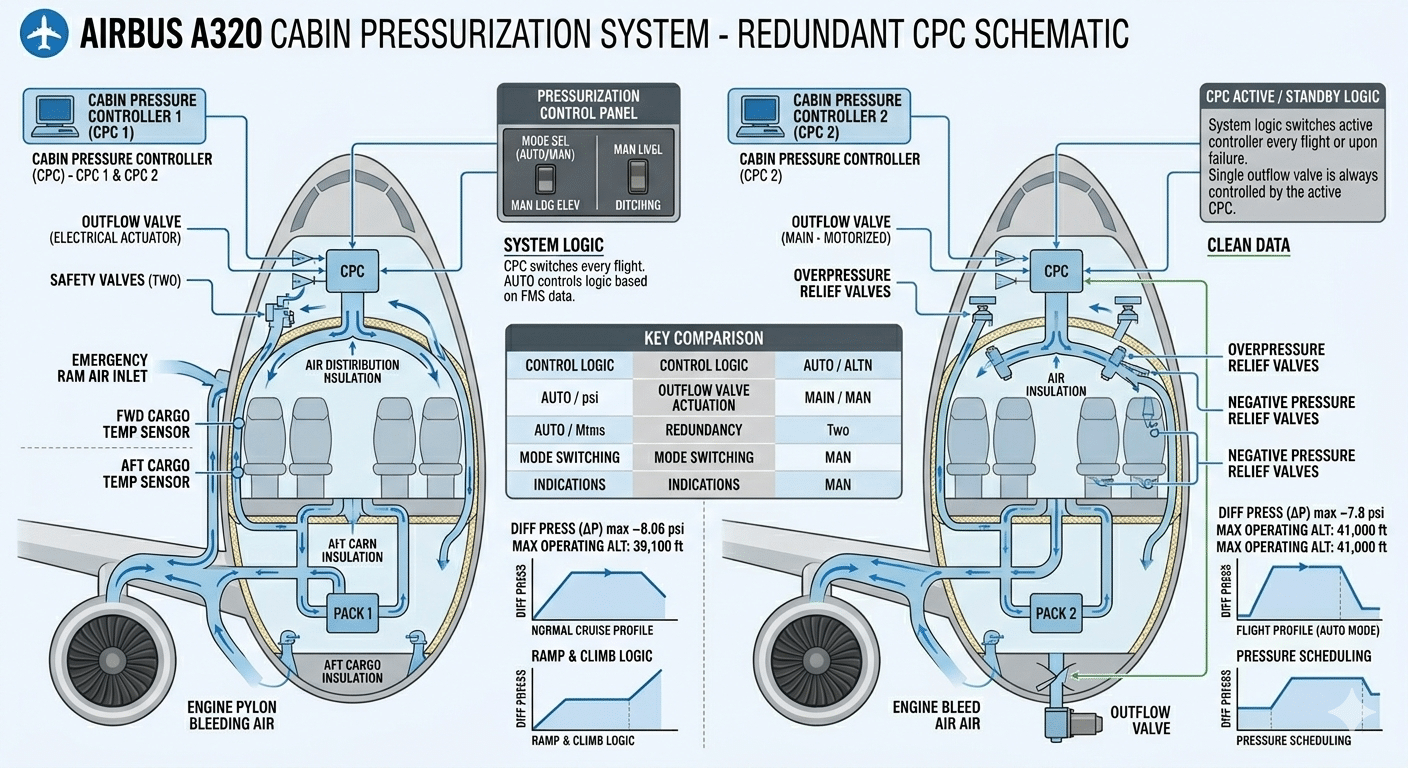
The A320 emphasizes automation, with two redundant Cabin Pressure Controllers (CPCs) managing a single outflow valve. In normal operation, the pressurization schedule is largely hands-off: the controllers use aircraft data (including FMGS inputs such as flight profile and landing field elevation) to plan cabin pressure changes through climb, cruise, and descent. Cabin rates are optimized for passenger comfort and structural limits rather than pilot “feel.”
If cabin altitude reaches 9,550 feet, the crew receives an ECAM warning—commonly CAB PR EXCESS CAB ALT—and treats it as a time-critical event.
How the FMGS and CPCs Call the Shots
FMGS data feeds into the CPCs to support automatic scheduling. This includes flight profile logic and landing field information, allowing the system to smoothly transition toward landing elevation without abrupt pressure corrections. In day-to-day operations, crews typically monitor rather than actively control pressurization unless an abnormal procedure requires intervention.
Why Pre-Pressurization Matters During Takeoff
Airbus programs the A320 to pre-pressurize to about 0.1 psi before liftoff. In TAKEOFF mode, the system increases cabin pressure at a defined rate (commonly referenced around 400 ft/min) until the target differential is reached. This prevents a noticeable pressure “bump” at rotation.
Although 0.1 psi sounds minor, it smooths the transition as external pressure begins decreasing immediately after liftoff, avoiding a sudden step change in cabin pressure.
Why Boeing 737 Pilots Still Like Having Control
Boeing’s philosophy traditionally retains more direct crew authority. Many 737 variants provide AUTO, ALTN, and MAN modes, allowing crews to remain automated during normal operations while retaining rapid access to manual control if needed. The control panel typically includes a cabin rate selector adjustable between approximately 50 and 2000 fpm, depending on model.
Newer 737 variants support maximum differential pressure around 9.1 psi, while older variants are typically closer to 8.65 psi. Exact limits vary by series and certification standard.
Switching Between AUTO and ALTN Modes
Moving from AUTO to ALTN keeps pressurization logic active while transferring control to the alternate controller channel, providing redundancy without fully reverting to manual control.
Mastering the Manual Cabin Rate Selector
Manual mode allows direct adjustment of cabin rate within the selectable range. Lower rates improve passenger comfort, while higher rates may be useful during non-standard profiles such as rapid descents.
Honestly, Is the Air We Breathe Actually Safe?
Busting the Door and Bullet Hole Myths
Opening a plug-type cabin door at cruise altitude is effectively impossible because the pressure load from differential pressure holds it firmly sealed. Minor fuselage punctures typically result in slow decompression rather than explosive Hollywood-style events, though any structural damage is treated seriously.
The Truth About Filters and Oxygen Masks
Cabin air is typically refreshed every two to three minutes in modern airliners. A portion is recirculated through HEPA filters rated at approximately 99.97% efficiency for relevant particle sizes.
If cabin altitude exceeds safe thresholds, passenger oxygen masks deploy. Many systems use chemical oxygen generators while the crew initiates a rapid descent to a breathable altitude—typically around 10,000 feet, terrain permitting.
What’s the Future of Pressurization?
Future developments emphasize enhanced health monitoring, longer maintenance intervals, and weight reduction. Manufacturers are integrating smarter diagnostics to detect faults earlier and improve reliability while reducing lifecycle operating costs.
Health Monitoring and Real-Time Fault Detection
Advanced monitoring systems can track system trends and identify anomalies before they escalate, reducing unscheduled maintenance events.
The Push for Lightweight and Sustainable Tech
Reducing component weight improves fuel efficiency over an aircraft’s lifespan. Even modest weight savings can produce measurable long-term reductions in fuel burn and emissions.
A Quick Cheat Sheet for the Terminology
Understanding Differential and Ambient Pressure
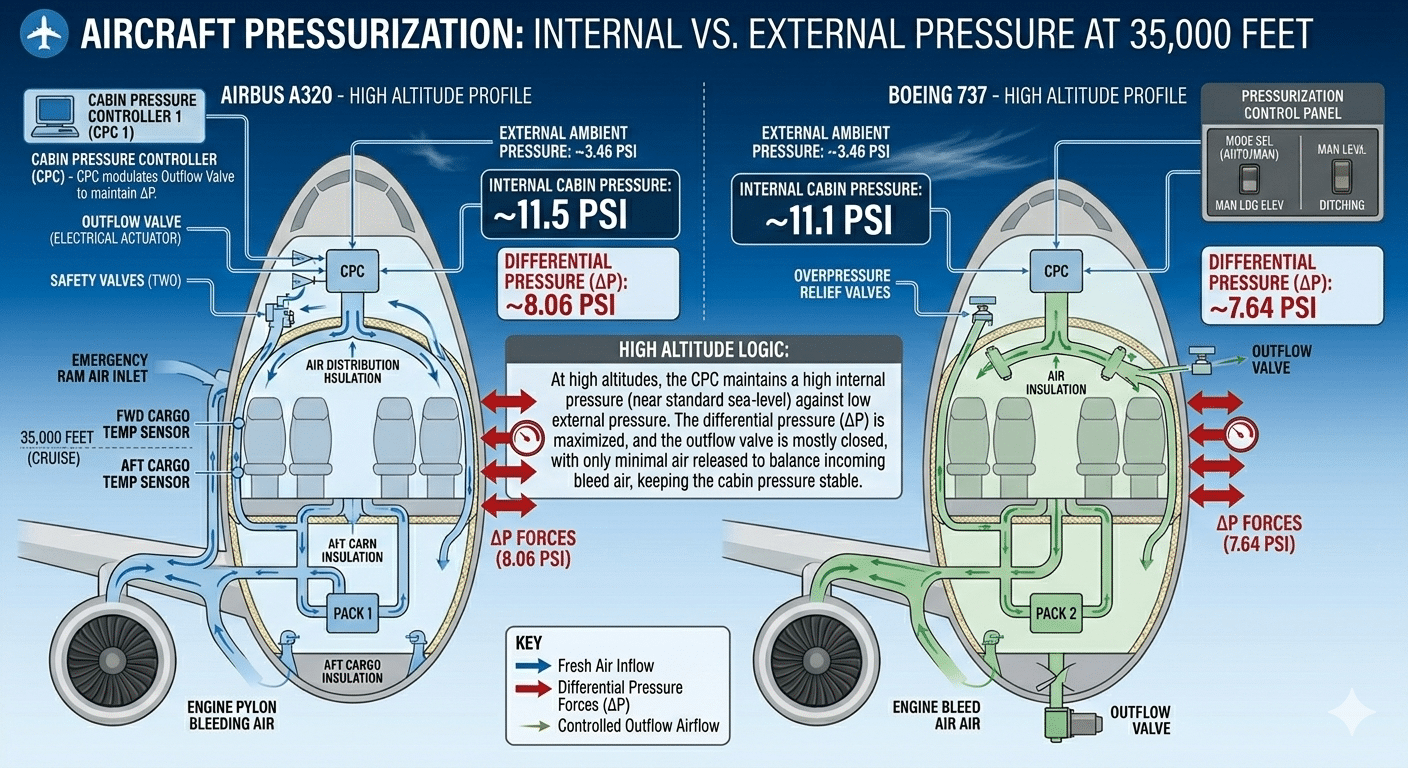
Differential pressure is the difference between cabin air pressure and outside ambient air pressure. Ambient pressure refers to the air surrounding the aircraft. Cabin altitude expresses cabin pressure as an equivalent altitude above sea level.
Why the Outflow Valve Is the Real MVP
The outflow valve regulates how much air exits the fuselage to maintain commanded cabin pressure and cabin rate. While packs supply airflow into the cabin, the outflow valve continuously adjusts to maintain the desired pressure schedule.
Because pressurization failures at altitude can quickly become critical, both the A320 and 737 incorporate redundancy and alternate/manual control paths.
Final Words
Both Airbus and Boeing achieve the same safety outcome through different design philosophies. The A320 leans heavily on automation and flight management integration, while the 737 preserves more direct pilot authority. Operationally, success depends on recognizing normal indications, understanding alert logic, and transitioning smoothly between modes when necessary.
Frequently Asked Questions
What cabin altitude do the A320 and 737 maintain?
Both aircraft are designed to maintain cabin altitude at or below approximately 8,000 feet at maximum operating altitude, though actual cabin altitude varies depending on cruise level and phase of flight.
How does the A320 cabin pressurization system work?
The Airbus A320 uses two redundant Cabin Pressure Controllers (CPCs) that automatically regulate cabin pressure by commanding a single outflow valve using flight management and aircraft data.
How does the Boeing 737 pressurization system work?
The Boeing 737 includes AUTO, ALTN, and MAN modes. Automatic modes use digital controllers, while manual mode allows pilots to adjust cabin rate between approximately 50 and 2000 feet per minute.
Which aircraft has more automation in cabin pressurization?
The Airbus A320 is generally more automated, while the Boeing 737 provides more direct manual control options.
What is differential pressure in aircraft?
Differential pressure is the difference between cabin air pressure and outside ambient air pressure, allowing aircraft to maintain a breathable environment at high altitude.
What happens if cabin altitude reaches 9,550 feet in an A320?
If cabin altitude reaches approximately 9,550 feet, the crew receives an ECAM warning and must take immediate corrective action.
Can pilots manually control cabin pressure?
Yes. Both aircraft provide manual capability. The Boeing 737 includes a dedicated manual rate selector, while the Airbus A320 includes alternate and manual modes.
Is it possible to open a cabin door mid-flight?
No. Plug-type aircraft doors cannot be opened at cruise altitude because internal differential pressure holds the door sealed.
How often is cabin air refreshed?
Modern airliners typically refresh cabin air every two to three minutes, with a portion recirculated through HEPA filters rated at approximately 99.97% efficiency.
Why do oxygen masks deploy during a pressurization failure?
Passenger oxygen masks deploy if cabin altitude exceeds safe limits, supplying oxygen while the crew initiates a descent to a breathable altitude, typically around 10,000 feet.