

737 vs a320
Boeing 737 vs Airbus A320: Key Differences for Pilots and Passengers

Mar
The 737 vs A320 debate is really a comparison between the two defining narrow-body aircraft families in modern commercial aviation. The Boeing 737 and Airbus A320 family serve the same broad mission: high-frequency short- and medium-haul airline flying. They overlap heavily in size, capacity, and route profile, but they differ in cockpit philosophy, family commonality, cabin feel, and how each manufacturer thinks about automation.
Quick answer: the Boeing 737 tends to appeal to people who like a more traditional flight deck with a yoke and strong continuity across generations, while the Airbus A320 is known for fly-by-wire, a sidestick, and tightly integrated family commonality. For passengers, the difference is usually subtle. For pilots and airlines, it can be significant.
| Category | Boeing 737 | Airbus A320 family |
|---|---|---|
| Mission | Single-aisle jet for short- and medium-haul routes | Single-aisle family for short- and medium-haul routes |
| Cockpit philosophy | Traditional yoke, interlinked controls, familiar Boeing logic | Sidestick, full digital fly-by-wire, strong automation |
| Family structure | 737NG remains a fleet workhorse; 737 MAX is the current product line | A318, A319, A320, and A321 share strong cockpit and training commonality |
| Passenger angle | Cabin comfort depends heavily on airline layout and generation | Known for wider cabin feel and wider seats in many layouts |
Quick overview of the Boeing 737 and Airbus A320
The first thing to understand is that “737” and “A320” are family names, not single airplanes. On the Boeing side, the big split is between the older 737NG generation and the newer 737 MAX. Boeing now treats the 737NG as a non-production model that still serves customers worldwide, while the MAX is its current single-aisle sales focus.
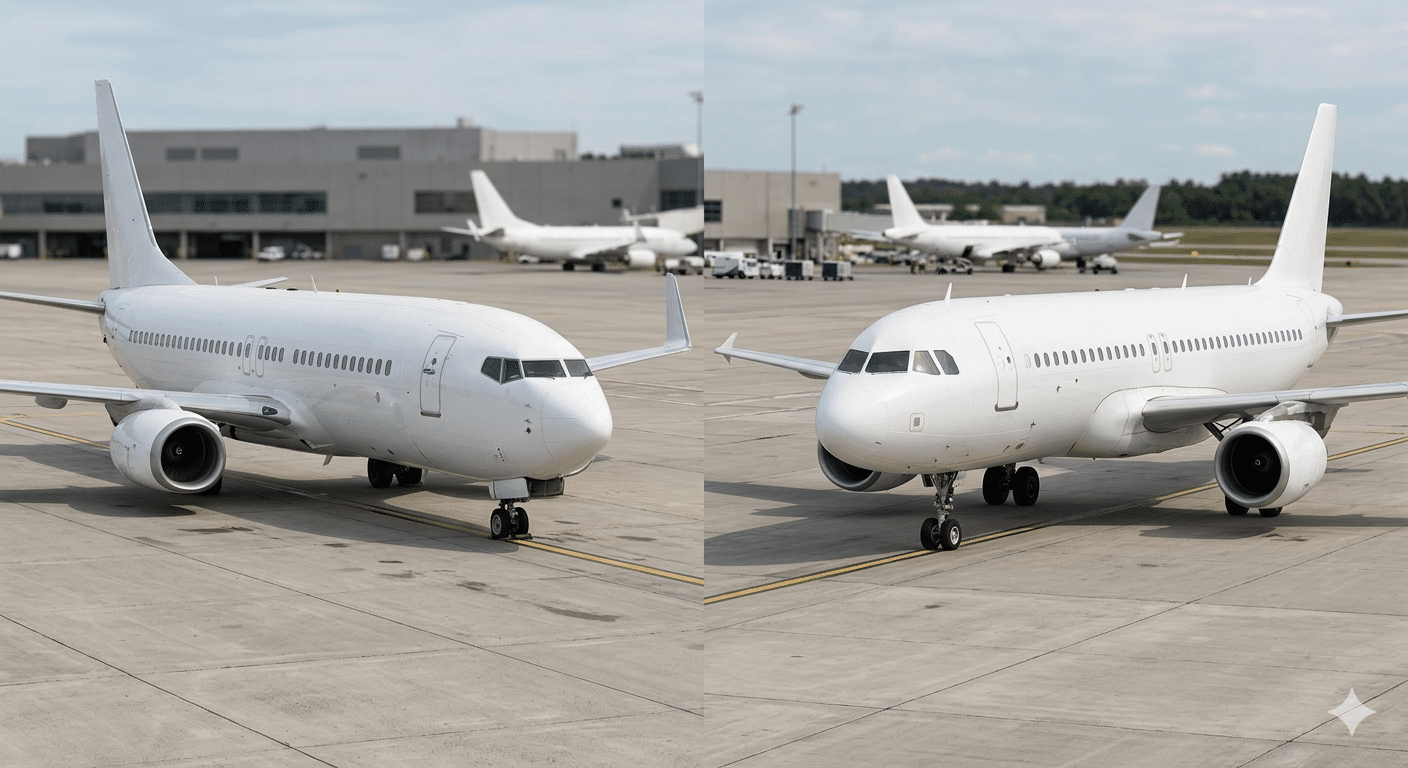
On the Airbus side, the A320 family includes the A318, A319, A320, and A321, plus neo versions. Airbus explicitly sells this as a family with strong commonality, which is why the phrase boeing 737 vs airbus a320 is partly about numbers and partly about philosophy.
Size and dimensions: which aircraft is bigger?
The fairest classic comparison is Boeing 737-800 versus Airbus A320-200. Boeing lists the 737-800 at 39.5 m long, with 162 seats in a typical two-class layout and a maximum of 189. Airbus lists the A320-200 at 37.57 m long, with 140 to 170 seats in two classes and a maximum of 180.
So which airplane is bigger? In this mainstream matchup, the 737-800 is slightly longer and often slightly denser. But at the family level, the answer changes by variant. The A321 is larger than the core A320, and the 737 MAX line also stretches upward. That is why serious comparisons should be variant to variant, not family name to family name.
Cabin width, seat comfort, and wider seats
The cabin story is where many travelers start to notice a real difference. Airbus markets the A320 family around one of the widest single-aisle cabins in its class, and the company highlights 18-inch-wide seats in the Airspace cabin. Airbus lists the A320-200 and A320neo with a 3.95 m fuselage width and a 3.70 m maximum cabin width.
Boeing’s answer is less about raw width and more about presentation. On the 737 MAX, Boeing emphasizes the Boeing Sky Interior, larger pivoting bins, advanced LED lighting, and larger windows. That means the practical comfort question is not just “Which fuselage is wider?” It is also “Which airline installed better seats, more pitch, and a newer cabin?”
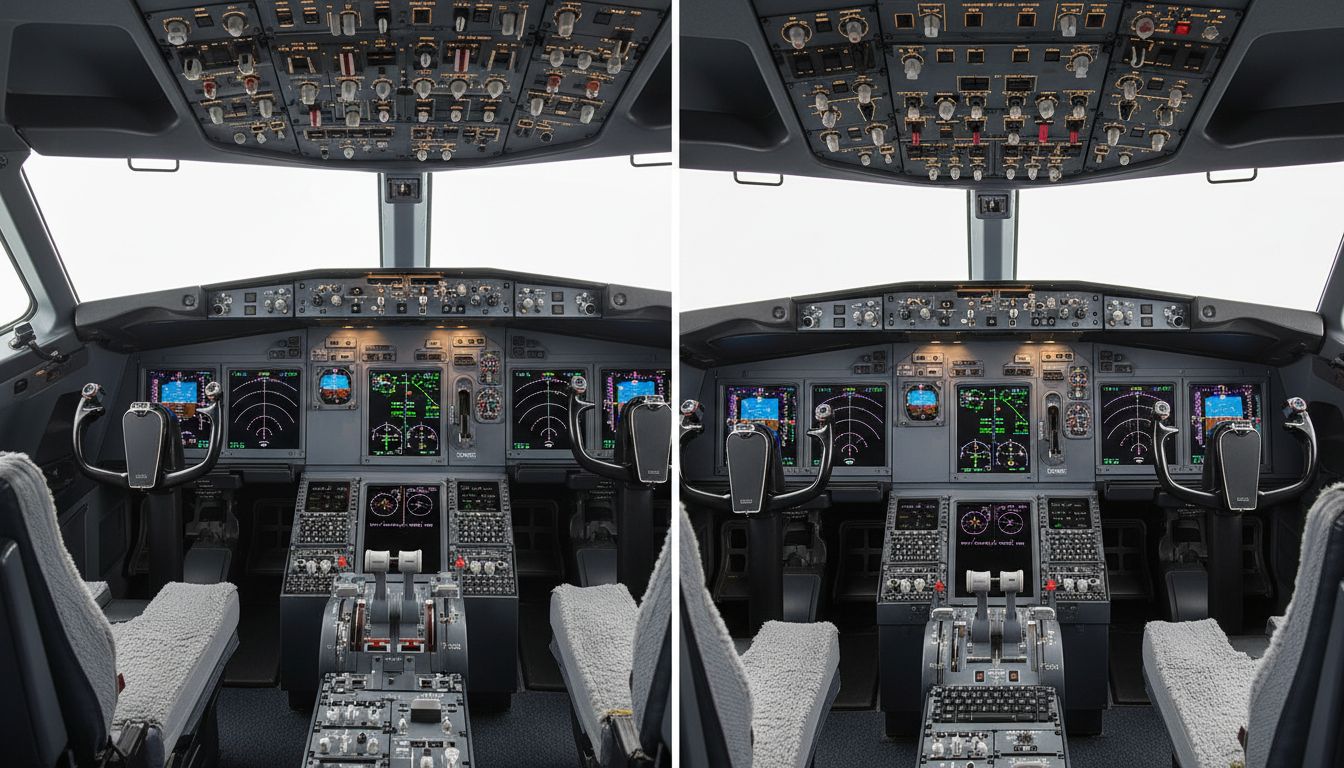
That is why cabin comfort is best judged at airline level. A tired old A320 can feel worse than a fresh 737 MAX, and a well-equipped A320neo can feel more spacious than an older 737NG. For economy and business class travelers alike, airline layout matters more than internet brand loyalty.
Flight deck differences: yoke vs sidestick
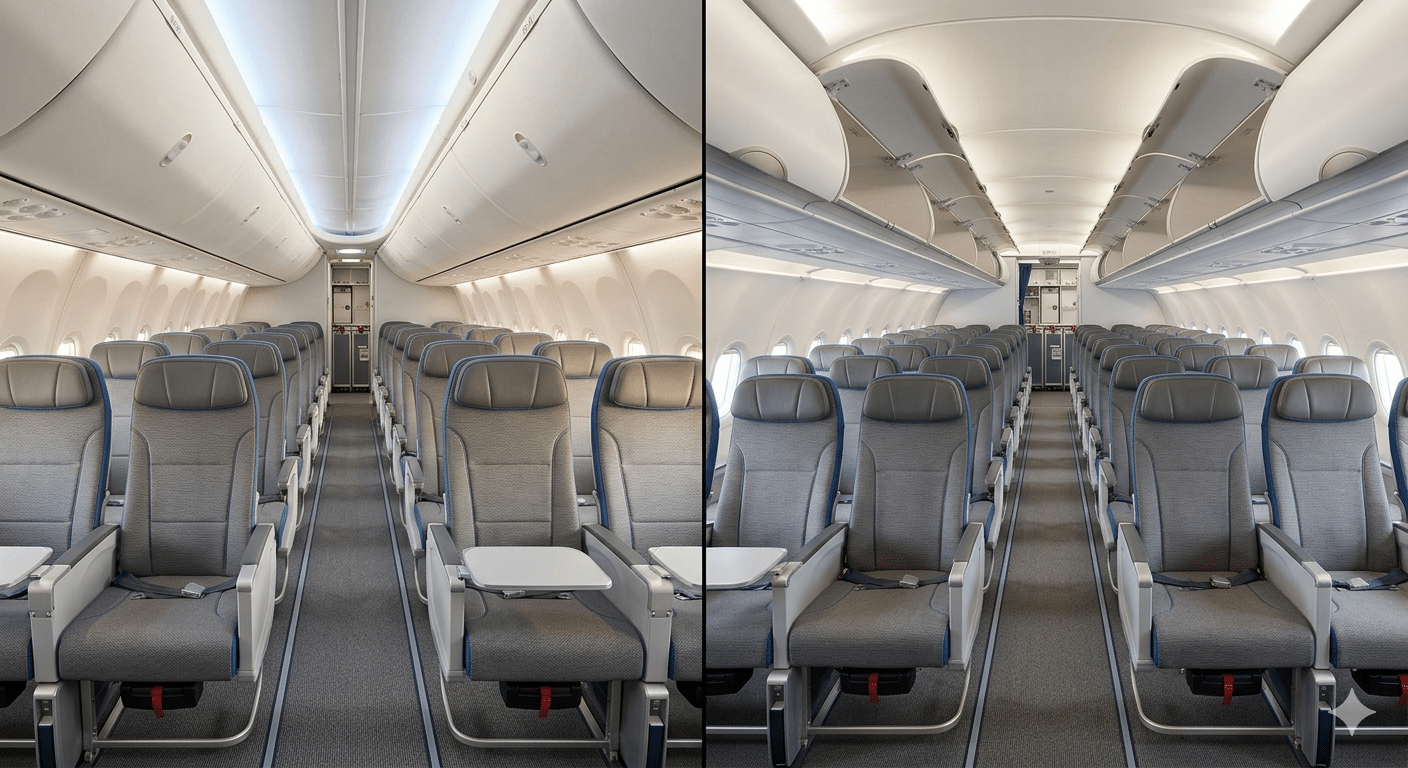
This is the core design divide. Boeing says the 737NG uses large-displacement flight controls and interlinked controls so both pilots can immediately sense control input, whether it comes from the other pilot or the autopilot. That traditional 737 cockpit logic is a major reason many crews find the airplane intuitive.
Airbus made the opposite design choice famous. The A320 was the first commercial aircraft to use full digital fly-by-wire, replacing traditional manual signaling with electronic inputs. Instead of a yoke, pilots use a sidestick. Airbus also ties that to family commonality: pilots can fly the A318, A319, A320, and A321 with a single type rating because the cockpits and procedures are aligned.
Fly-by-wire, automation, and handling philosophy
The Airbus A320 family is built around software-mediated control logic and flight-envelope protections. Boeing’s 737 philosophy is more evolutionary. Boeing emphasizes pilot authority, familiar control architecture, and continuity with earlier 737s, while still adding modern avionics. On the 737 MAX, Boeing highlights four large 15-inch displays, the same display size class it references on the 787 and 777X.
This difference explains a lot of pilot debate. Some pilots prefer the Airbus model because the automation is highly structured, the cockpit is standardized, and the family commonality is strong. Others prefer Boeing because the 737 feels closer to the traditional way many pilots picture flying an airplane. That is why “Why do pilots prefer Boeing or Airbus?” never has a single answer.
Performance comparison: range, speed, runway needs, and fuel consumption
At current-generation level, the numbers are close. Boeing lists the 737 MAX 8 at 3,500 nautical miles of range. Airbus lists the A320neo at 3,400 nautical miles. Airbus lists both the A320-200 and A320neo at M0.82. In other words, both are clearly in the same narrow-body performance neighborhood.
Fuel consumption is more about generation and mission than about brand slogans. Airbus says the A320neo delivers at least 20% lower fuel burn and CO2 emissions per seat than the previous generation. Boeing markets the 737 MAX around better fuel efficiency, improved aerodynamics, LEAP-1B engines, and lower emissions than earlier 737s. For airlines, the real question is not “Which family is always more efficient?” but “Which variant works best on this route, at this density, inside this fleet?”
Runway needs are also mission-specific. Weight, engine option, airport elevation, temperature, and payload all matter. For a comparison article, the most honest answer is that both families are proven, highly capable narrow-bodies rather than claiming one universal runway winner.
Boeing 737-800 vs Airbus A320-200
If you want the most useful legacy matchup, this is it. The boeing 737-800 became one of the world’s most common airline jets because it offered a strong mix of range, capacity, and familiar Boeing logic. The airbus a320-200 answered with similar mission coverage, a cabin that many passengers find more spacious, and the same Airbus design language that later influenced aircraft commonality across families such as the A330 and A350.
That is why the classic comparison still works. The 737-800 feels like the traditional Boeing narrow-body workhorse. The A320-200 feels like the airplane that pushed Airbus commonality, automation, and cabin width into the center of the market.
737NG, 737 MAX, and the broader A320 family
The phrase boeing 737 vs anything can be misleading unless you say which generation you mean. The 737NG covers aircraft such as the 737-700, 737-800, and 737-900. The 737 MAX is the newer generation and Boeing’s present single-aisle focus. The A320 family, meanwhile, covers a broader ladder from the A318 to the A321, with neo versions expanding the offer further.
This matters because airlines do not compare a single jet in isolation. They compare training, maintenance, scheduling, spares, and overall fleet fit. Airbus has a strong argument in commonality. Boeing has a strong argument in continuity, familiarity, and a huge installed base of 737 experience across the industry.
Safety record and operational reputation
Safety questions need careful wording. There is no responsible one-line answer to “Is an Airbus safer than a Boeing 737?” because brand-level comparisons flatten too many variables. A 737NG is not the same aircraft type as a 737 MAX in generational terms, and an A320-200 is not identical to an A320neo.
What you can say fairly is this: the A320 family is historically important because it brought full digital fly-by-wire and protection logic into mainstream airline service, while Boeing’s 737 family is defined by a more traditional cockpit philosophy and a long operational legacy. For passengers, the smartest way to think about safety is through airline standards, training, maintenance, and regulatory oversight, not fan arguments about logos.
Which aircraft do pilots prefer?
Pilot preference usually follows philosophy. Pilots who like a traditional yoke, interlinked controls, and a familiar Boeing feel often prefer the 737. Pilots who like a clean Airbus flight deck, standardized procedures, and strong automation often prefer the A320 family. So the better question is not “Which one do pilots prefer?” but “What kind of cockpit logic do they prefer?”
Which aircraft do airlines prefer for fleet commonality and economics?
Airlines buy airplanes for route economics, crew planning, and operational fit. Airbus promotes the A320 family’s common cockpit and single type rating structure. Boeing promotes reliability, ease of maintenance, and the fact that generations of airlines already know the 737 ecosystem. In real life, the cheaper choice is often the one that fits the airline’s existing operation best.
Final verdict: 737 vs A320
The best conclusion is a balanced one. The Boeing 737 and Airbus A320 are both outstanding narrow-body families, but they win for different reasons.
- Boeing 737: stronger traditional cockpit identity, familiar Boeing feel, and deep airline legacy.
- Airbus A320: stronger family commonality, fly-by-wire logic, and a cabin that many travelers perceive as more spacious.
- Best rule: compare 737-800 vs A320-200 or 737 MAX 8 vs A320neo, not just the family labels.
For passengers, airline layout often matters most. For pilots, control philosophy matters most. For airlines, economics and fleet strategy matter most.
FAQ
Do pilots prefer 737 or A320?
Preference is split. Boeing attracts pilots who like traditional controls, while Airbus attracts those who like sidestick flying, automation, and cockpit commonality.
Is an Airbus safer than a Boeing 737?
That is too broad to answer well. Safety should be discussed by variant, operator, training standard, maintenance quality, and regulatory context.
Why do pilots prefer Boeing or Airbus?
Because they represent different philosophies: Boeing emphasizes a more conventional pilot interface, while Airbus emphasizes fly-by-wire, protection logic, and cross-family commonality.
Which plane has the better range and speed, the 737 or A320?
Mainstream current variants are very close. Boeing lists the 737 MAX 8 at 3,500 nm, while Airbus lists the A320neo at 3,400 nm.
How do the interiors of the 737 and A320 compare?
The A320 family is known for a wider cabin feel and wider seats in many layouts, while the 737 MAX focuses on the Boeing Sky Interior, lighting, bins, and larger windows. The airline’s cabin layout is usually the biggest comfort variable.
Which is bigger, the A320 or the 777?
The 777 is much bigger. Boeing lists the 777-200LR at 317 seats in two classes and the 777-300ER at 392, while the core A320 sits in the narrow-body range. The 777 is a widebody long-haul jet; the A320 is a single-aisle narrow-body.